
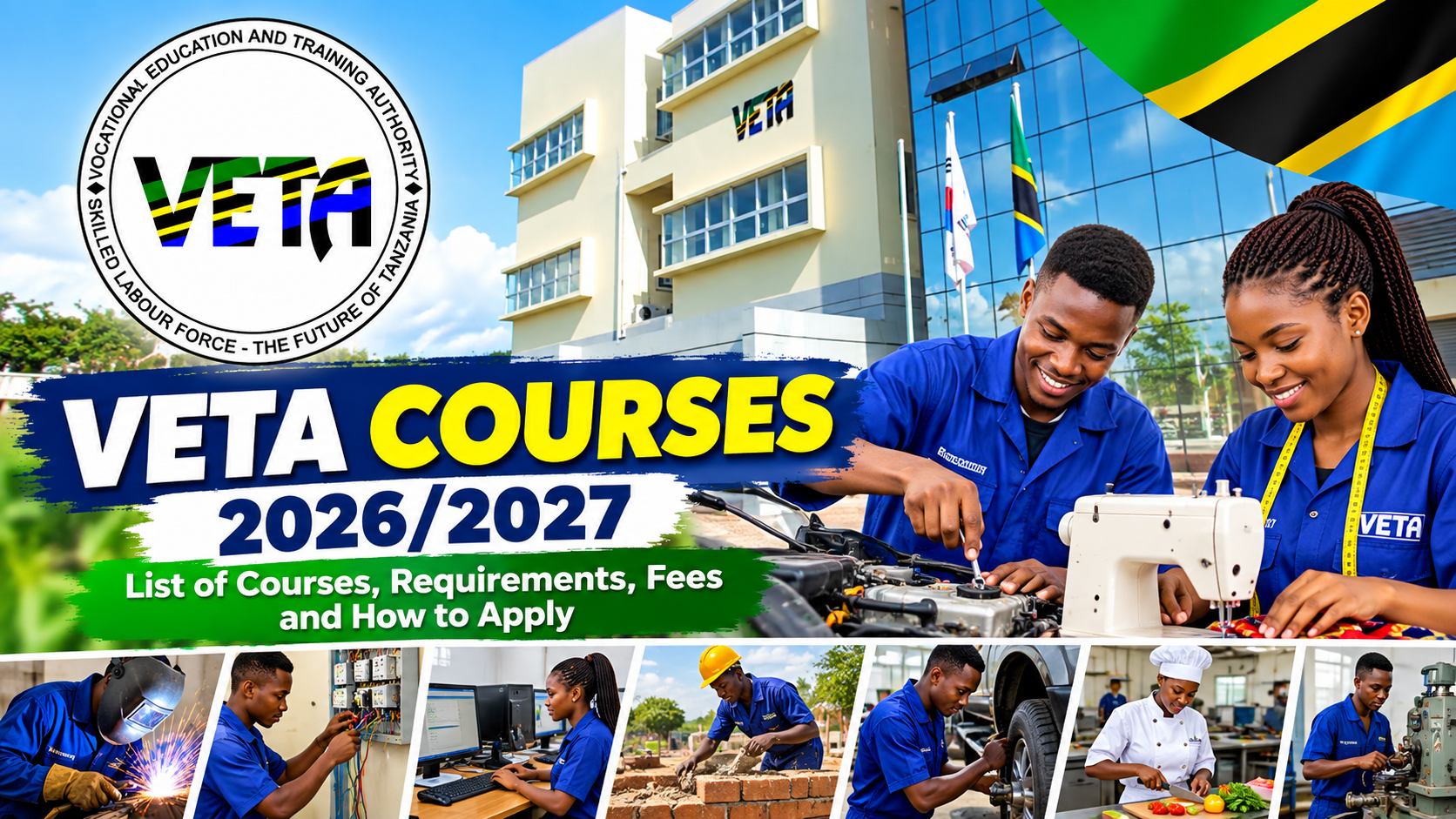
Discover potential VETA courses in Tanzania for 2026/2027, including ICT, electrical, mechanics, welding, plumbing, hospitality and other practical career skills.
Potential VETA Courses in Tanzania 2026/2027:
Choosing a vocational course is becoming an important option for students who want to gain practical skills and enter the world of work without spending many years in university.
In Tanzania, the Vocational Education and Training Authority (VETA) provides training in different technical and vocational fields. These include areas such as electrical installation, motor vehicle mechanics, information and communication technology, welding, plumbing, carpentry, food production, tailoring and several other practical occupations.
But when students ask, “Which VETA course has potential?”, they are usually asking a bigger question: Which course can give me useful skills that I can use to find employment or start my own business?
There is no single VETA course that is guaranteed to make everyone successful. Your interests, practical ability, location, experience and the demand for a particular skill all matter. However, some fields can be particularly useful because they provide skills that can be applied directly in workplaces or self-employment.
Below are some VETA courses worth considering in Tanzania for 2026/2027.
1. Electrical Installation
Electrical Installation is one of the technical fields available at several VETA centres.
The course focuses on practical skills related to electrical wiring, installation, maintenance and basic electrical systems.
This can be useful for someone who wants to work in construction, maintenance or electrical services. It can also provide a foundation for someone who eventually wants to offer electrical services independently.
For example, VETA centres in different regions list Electrical Installation as a long course, although the duration and exit level can vary from one centre to another.
Possible areas of work include:
- Electrical installation
- Building maintenance
- Electrical repair services
- Construction projects
- Industrial maintenance
- Self-employment
If you enjoy working with electrical systems and practical problem-solving, this is one field you can consider.
2. Motor Vehicle Mechanics
If you are interested in vehicles, Motor Vehicle Mechanics is another practical VETA field worth looking at.
The training is designed to give students practical knowledge of vehicle maintenance and repair.
Several VETA centres list Motor Vehicle Mechanics among their long-course programmes. For example, Mara VTC lists the course at Level III with a three-year duration, while other centres offer different durations and levels.
After training, a student can explore opportunities in:
- Vehicle garages
- Transport companies
- Automotive workshops
- Vehicle maintenance businesses
- Fleet maintenance
- Self-employment
The automotive field also changes with technology, so continuing to develop your skills after completing the course can be important.
3. Auto Electrical
Modern vehicles depend heavily on electrical and electronic systems.
That makes Auto Electrical another interesting technical field for students who enjoy both vehicles and electrical systems.
VETA centres such as Mara VTC and Dar es Salaam RVTSC list Auto Electrical among their vocational programmes.
Training in this area can help students develop skills related to vehicle electrical systems, diagnosis and repair.
It may be suitable for someone who wants to work in automotive workshops or eventually establish an auto-electrical service business.
4. Information and Communication Technology (ICT)
Technology continues to influence almost every sector, and VETA also offers training in Information and Communication Technology.
For example, VETA Kipawa ICT Centre lists ICT as a long course, together with Electronics and Electrical Installation. The centre also lists areas such as computer applications, graphics design, website design and PC maintenance among its short-course offerings.
ICT can therefore be interesting for students who want to build skills in:
- Computer applications
- Website development
- Graphics design
- Computer maintenance
- Networking
- Digital work
One advantage of digital skills is that some services can potentially be offered beyond your immediate local area.
However, learning ICT should not stop with the certificate. Practice is very important. Building websites, creating designs, learning software and developing a portfolio can make your skills more useful.
5. Welding and Metal Fabrication
Welding and Metal Fabrication is another practical field offered by VETA centres in different parts of Tanzania.
The field can be useful in construction, fabrication workshops, manufacturing and repair work.
VETA listings show Welding and Metal Fabrication as a long course at centres such as Mwanza RVTSC and Mara VTC.
A student who becomes skilled in welding can work for an employer or gradually develop an independent workshop.
The skill can be applied to products and services such as:
- Metal doors
- Windows
- Gates
- Furniture
- Structural metalwork
- Repairs and fabrication
For someone with an entrepreneurial mindset, welding can therefore be combined with business skills to create a small enterprise.
6. Plumbing and Pipe Fittings
Buildings need reliable water and plumbing systems, which makes Plumbing and Pipe Fittings another practical vocational field.
The course appears in VETA listings from several regions. For example, Mwanza RVTSC and Dar es Salaam RVTSC list Plumbing and Pipe Fittings among their long-course programmes.
Students can develop practical skills that may be applied in:
- Residential construction
- Commercial buildings
- Plumbing maintenance
- Water installation
- Repair services
- Construction companies
Plumbing is also a field where practical experience matters. A student who combines formal training with hands-on experience can continue developing their skills after graduation.
7. Carpentry and Joinery
If you enjoy working with wood and creating physical products, Carpentry and Joinery may be worth considering.
VETA centres in different regions list Carpentry and Joinery among their long courses. Mara VTC, for example, lists the course as a two-year programme, while other centres have different durations.
The skills can be used to make:
- Doors
- Tables
- Chairs
- Beds
- Cabinets
- Office furniture
- Custom wooden products
This is also one of the fields where a skilled graduate can potentially move into self-employment by starting a small workshop.
8. Design, Sewing and Clothing Technology
For students interested in fashion and clothing, Design Sewing and Clothing Technology provides another vocational pathway.
The course is listed by VETA centres in several regions, including Mara VTC and Kanadi VTC.
The skills can be applied in:
- Tailoring
- Fashion design
- Clothing production
- Garment alteration
- Small clothing businesses
- Fashion entrepreneurship
This field can be especially practical for someone who wants to combine technical skills with creativity.
You do not necessarily have to work for someone else after completing the training. With good sewing skills, quality work and proper business management, a graduate can build a customer base and grow gradually.
9. Food Production
Food-related skills can also create different opportunities.
VETA centres list Food Production among their programmes. Some centres also offer Food and Beverage Service and Sales, Front Office Operations and other hospitality-related fields.
Food Production can be useful for students interested in:
- Restaurants
- Hotels
- Catering
- Bakeries
- Food businesses
- Hospitality services
The VETA Hotel and Tourism Training Institute in Arusha, for example, lists Food Production, Front Office Operations, Food and Beverage Service and Sales, and Tour Guiding.
10. Refrigeration and Air Conditioning
Another technical area students can explore is Refrigeration and Air Conditioning.
This field involves practical skills related to refrigeration and cooling systems.
VETA listings show Refrigeration and Air Conditioning among courses offered at some centres, including centres that provide both long and short training options.
The skills may be useful in:
- Appliance repair
- Air conditioning services
- Refrigeration maintenance
- Commercial facilities
- Hotels
- Workshops
- Self-employment
For someone who enjoys technical troubleshooting, this can be an interesting area to explore.
11. Agro Mechanics
Tanzania has a large agricultural sector, and technical skills related to agricultural machinery can also be useful.
Agro Mechanics is listed by some VETA centres, including Arusha VTC and Mpanda VTC.
The field can provide practical knowledge related to agricultural machinery and equipment.
It may be particularly relevant to students who come from agricultural communities or who are interested in combining farming with technical skills.
12. Tour Guiding and Hospitality Courses
For students interested in tourism, VETA also provides training connected with the hospitality and tourism sector.
Courses listed across VETA centres include:
- Tour Guiding
- Food Production
- Front Office Operations
- Food and Beverage Service and Sales
- Housekeeping and Laundry Service
VHTTI in Arusha, for example, lists Food Production, Front Office Operations, Food and Beverage Service and Sales, and Tour Guiding.
These courses may be relevant for students interested in hotels, restaurants, tourism companies and related businesses.
What Makes a VETA Course “Potential”?
The word potential can mean different things to different students.
A course may have good potential if it gives you a skill that can be used in several ways rather than preparing you for only one narrow type of job.
For example, a student who studies electrical installation may work for a company, work on construction projects, provide maintenance services or eventually establish a small business.
The same idea can apply to plumbing, welding, carpentry, tailoring, motor vehicle mechanics and other practical fields.
But there is an important point to remember:
A course alone does not guarantee employment or business success.
Your practical ability, discipline, experience, communication skills and ability to find customers or employment can make a major difference.
Long Courses vs Short Courses at VETA
VETA centres offer both Long Courses and Short Courses.
The exact duration depends on the course and training centre. VETA’s course database shows examples ranging from short programmes lasting weeks or months to long courses lasting one, two or three years.
Long Courses
Long courses are generally designed to provide more comprehensive vocational training.
They may be suitable for students who want to develop a stronger foundation in a particular occupation.
Short Courses
Short courses can be useful for someone who wants to learn a specific skill within a shorter period.
For example, VETA listings include short courses in areas such as driving, welding, computer applications, plumbing, tailoring and electrical installation.
So, kama una muda mfupi, a short course can be an option. If you want more extensive vocational training, you may consider a long course.
How to Choose the Right VETA Course
Before applying, do not choose a course simply because someone tells you that it has “money.”
Instead, ask yourself a few questions.
1. What kind of work do I enjoy?
If you like vehicles, Motor Vehicle Mechanics or Auto Electrical may make more sense than choosing a course you have no interest in.
2. Do I prefer technical or creative work?
Electrical, welding, mechanics and plumbing are highly practical technical areas.
Fashion and clothing, graphics and related fields may appeal more to students who enjoy creative work.
3. Where do I want to work?
Think about opportunities in your region.
A course that is useful in one location may have different opportunities elsewhere.
4. Do I want employment or self-employment?
Some vocational skills can be used for both.
For example, a trained carpenter can seek employment in a workshop or gradually establish a personal workshop.
5. Have I checked the actual VETA centre?
This is important.
Not every VETA centre offers every course. The official VETA course database lists courses according to individual centres, so students should check the specific centre before applying.
VETA Courses and Fees
There is no single fee that applies to every VETA course across Tanzania.
The official VETA listings show that fees can differ depending on the centre, course and training type. For example, some VETA long courses in the database are listed at TSh 60,000 or TSh 120,000, while other centres and programmes show different amounts.
Because course information can change, students should confirm the current fee directly with the training centre before making payment.
Do not rely on an old social media post when paying school fees.
Where Can I Find VETA Courses?
The best starting point is the official VETA course and centre information.
The VETA database allows students to see the courses associated with individual registered centres, including the course type, duration and exit level.
When searching for a course, check:
- Name of the VETA centre
- Region and district
- Course name
- Long or short course
- Duration
- Exit level
- Current fees
- Admission information
Final Thoughts
Choosing a VETA course is not only about finding a course that sounds popular. It is about finding a skill that matches your interests, abilities and future plans.
Fields such as Electrical Installation, Motor Vehicle Mechanics, Auto Electrical, ICT, Welding, Plumbing, Carpentry, Food Production, Fashion and Clothing, Refrigeration and Air Conditioning, Agro Mechanics and Tourism can all provide practical skills, depending on the student’s goals and the opportunities available around them.
Most importantly, do your research before applying. Course availability, fees and duration can vary from one VETA centre to another, so always confirm the latest information with the specific centre.
For students planning to join vocational training in Tanzania for the 2026/2027 academic year, choosing a practical skill and taking the training seriously can be an important first step toward employment, entrepreneurship or further technical education.

